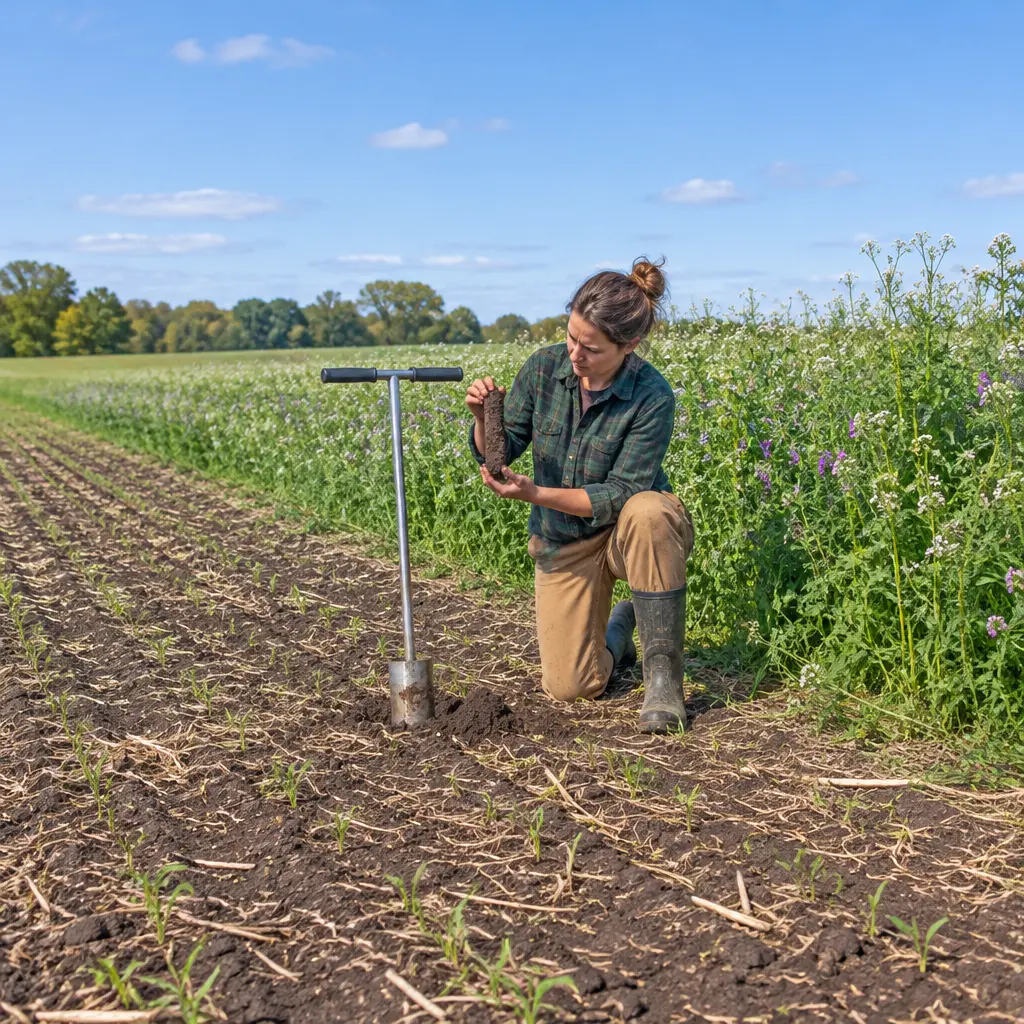
Soil health regeneration is the process of restoring soil’s capacity to function as a living ecosystem, not merely adjusting its nutrient concentrations. Measuring carbon sequestration—the transfer of atmospheric carbon into soil organic matter—therefore requires more than routine tests for nitrogen, phosphorus, and potassium. It calls for baseline and repeated measurements of soil organic carbon (SOC), bulk density, soil depth, and management history, interpreted alongside indicators such as aggregation, biological activity, and erosion. The need is substantial: the Intergovernmental Panel on Climate Change estimates that soils contain about 2,400 gigatonnes of carbon in the top metre globally, making even small changes in soil carbon stocks important, while also difficult to measure reliably.
Soil Health Regeneration Defines Carbon Sequestration Beyond Nutrient Levels
The Food and Agriculture Organization of the United Nations describes soil health through the soil’s continuing capacity to function as a living system, supporting plants, animals, and people. In this context, soil health regeneration means improving that capacity over time through practices such as keeping soil covered, reducing disruptive tillage, diversifying crops, maintaining living roots, and returning organic material. Carbon sequestration is one potential outcome, but it is not the whole definition of soil health and should not be inferred from a single nutrient test.
Basic fertility tests are useful for diagnosing nutrient supply and guiding fertilizer decisions. They do not, by themselves, reveal whether carbon stocks are increasing, whether carbon is being lost below the sampled layer, or whether soil structure and biological functioning are improving. A more complete assessment combines carbon-stock measurements with physical, chemical, and biological indicators, then compares results across consistent sampling locations and time periods.
Soil organic carbon stocks
SOC is the carbon contained in soil organic matter, including decomposing residues, microbial products, and more persistent organic compounds. To determine a stock rather than a concentration, laboratories and researchers combine measured SOC concentration with bulk density, sampled depth, and the area represented. A higher percentage of carbon in a sample does not necessarily mean a larger stock if soil density or the mass of soil being compared differs.
The IPCC’s global estimate of roughly 2,400 gigatonnes of carbon in the upper metre of soil highlights both the climate relevance and the scale of the measurement challenge. Since soil carbon varies across short distances and with depth, credible monitoring requires representative sampling, consistent methods, and uncertainty reporting. Sampling only the surface can also miss carbon redistribution deeper in the profile.
Carbon sequestration and carbon-stock change
Carbon sequestration is the net addition of carbon to a defined pool over a specified period. In agricultural soils, a measured increase in SOC stock can indicate sequestration, but it should be assessed against a baseline and interpreted in light of management, climate, soil type, and sampling uncertainty. A one-time measurement describes a condition; it cannot establish a rate of change.
This distinction matters because carbon can enter soil through roots and residues while also leaving through decomposition, erosion, or dissolved-carbon movement. The result is a balance, not a direct measure of how much plant material was added. Where changes are small relative to natural spatial variability, repeated measurements and statistical treatment are needed before claiming a meaningful trend.
Soil health indicators beyond nutrients
A broader soil-health assessment may include aggregate stability, infiltration, compaction, water-holding capacity, microbial activity, earthworm abundance, pH, and nutrient availability. The U.S. Department of Agriculture’s Natural Resources Conservation Service presents soil health as an integrated assessment of physical, chemical, and biological functions. These indicators help explain how soil is changing, but none is a substitute for measuring SOC stocks when the claim concerns carbon sequestration.
The indicators are connected: better aggregation can reduce erosion and protect organic matter, while active roots and microbial communities influence carbon inputs and decomposition. Their responses may occur on different timelines, however. Infiltration or ground cover may improve before a detectable change in total SOC appears, so monitoring should match each indicator to the process it is intended to measure.
Soil Carbon Measurement Quantifies Change More Reliably
Soil carbon measurement is the set of sampling, laboratory, calculation, and comparison procedures used to estimate SOC concentration or stock and assess change. The central methodological principle is comparability: measurements should use a documented baseline, consistent depth and location strategy, validated laboratory methods, and a clear accounting boundary. As the topic moves from defining soil health to quantifying carbon, measurement design becomes the link between regenerative practice and defensible evidence.
Baseline sampling and repeat measurements
A baseline records soil conditions before, or at the start of, a management change. Repeat sampling should revisit representative locations and use comparable timing, depth intervals, and sample handling. Because field variability can obscure gradual change, a monitoring plan should specify sample numbers, sampling intervals, and how results will be aggregated before data are collected.
The USDA NRCS Soil Health Assessment Protocols emphasize standardized collection and interpretation of soil-health information. For carbon monitoring, composite samples can help represent a field area, but the design must preserve enough spatial information to estimate uncertainty and detect differences. Keeping georeferenced records and management histories makes later comparisons more useful.
Bulk density, depth, and equivalent soil mass
Bulk density is the mass of dry soil per unit volume. It is necessary for converting SOC concentration into an area-based stock, and it can change under practices that affect compaction, rooting, or organic matter. If bulk density is ignored, apparent carbon gains or losses may reflect a change in soil mass sampled rather than a true change in carbon stock.
Sampling to a consistent depth is important, but fixed-depth comparisons can be misleading when management changes soil density. Equivalent-soil-mass approaches compare the same mass of mineral soil across treatments or sampling dates. Researchers should also consider sampling below the surface layer where roots, tillage, or land-use change may redistribute carbon vertically.
Laboratory analysis and uncertainty
Laboratories commonly determine soil carbon using dry combustion, while some contexts require separating organic carbon from inorganic carbon, such as carbonates. The appropriate method depends on soil properties and the monitoring objective. Quality assurance—including documented methods, calibration, sample handling, and, where practical, reference materials—helps ensure that observed differences are not analytical artifacts.
The International Organization for Standardization’s soil-quality methods and national soil-monitoring protocols provide frameworks for consistent analysis. Results should be reported with uncertainty rather than as a precise number without qualification. Sampling error, laboratory error, seasonal variation, and natural field heterogeneity all influence how confidently a change can be attributed to management.
Regenerative Practices Influence Soil Carbon Through Multiple Pathways
Regenerative practices are management approaches intended to restore soil function, often by increasing plant cover and carbon inputs while limiting erosion and unnecessary disturbance. Their effects depend on local climate, soil texture, crop system, and prior management; a practice that benefits one field may produce a different response elsewhere. For that reason, practice adoption is evidence of a management change, not proof by itself that carbon has been sequestered.
Cover crops and continuous living roots
Cover crops are grown to protect and improve soil between or alongside cash crops. Their roots can add carbon belowground, reduce periods of bare soil, and support soil organisms; aboveground residues can also contribute organic inputs. Outcomes depend on species, biomass, termination timing, water availability, and whether the cover crop displaces other carbon inputs.
The 2019 National Academies of Sciences, Engineering, and Medicine report on negative emissions technologies concluded that agricultural soil-carbon practices have potential but require careful accounting and verification. It also underscores that sequestration rates and persistence vary across conditions. Cover crops are therefore best evaluated through measured changes and co-benefits such as erosion control, rather than assumed carbon credits based solely on acreage planted.
Reduced tillage and residue retention
Reduced tillage limits mechanical soil disturbance, while residue retention leaves crop material on the field. These practices can protect surface soil, reduce erosion, and alter decomposition and carbon distribution. However, changes may be concentrated near the surface, so measurements limited to shallow depths can overstate whole-profile gains if carbon has mainly been redistributed rather than added to the soil system.
The IPCC’s climate assessments recognize improved land management as a mitigation opportunity while emphasizing that permanence, additionality, and measurement uncertainty affect the climate value of stored carbon. A field-level assessment should therefore track soil depth, erosion risk, and management history alongside SOC, rather than treating reduced tillage as a guaranteed sequestration outcome.
Diversified rotations, agroforestry, and organic amendments
Diversified rotations and agroforestry can increase the variety and continuity of plant-derived inputs, while compost or manure can add organic carbon directly. These systems may also improve habitat, nutrient cycling, and water regulation. Yet imported amendments require careful accounting: carbon added to a field is not automatically carbon removed from the atmosphere if its production, transport, or alternative fate is not considered.
The National Academies’ assessment highlights the need to evaluate soil-carbon approaches within broader greenhouse-gas accounting. For example, manure application may increase SOC while also affecting nitrous oxide emissions, and tree-based systems may store carbon in both soil and biomass. A complete project assessment should identify which pools are included and avoid presenting soil gains as the entire climate balance.
Carbon Monitoring Connects Field Evidence to Climate Claims
Carbon monitoring combines field sampling with records, models, and verification to estimate whether management has changed soil carbon stocks. Direct soil sampling provides physical evidence but can be costly and slow; models and remote sensing can extend coverage but depend on assumptions and calibration. The strongest programs use these tools as complementary sources rather than treating any one method as universally sufficient.
Direct measurement, models, and remote sensing
Direct measurement involves collecting soil cores and analyzing them for carbon and related properties. Process-based models estimate carbon dynamics from soil, climate, and management inputs, while remote sensing can track vegetation cover, crop growth, and other surface conditions. Remote sensing does not directly measure belowground SOC, so it is generally used to support activity monitoring or model inputs rather than replace soil sampling.
The IPCC Guidelines for National Greenhouse Gas Inventories provide methods for estimating emissions and removals from land use and land management. These inventory methods support consistent reporting at national scales, but farm-level monitoring may require more detailed sampling and project-specific uncertainty analysis. A transparent report should state whether carbon values are measured, modeled, or a combination.
Permanence, additionality, and leakage
Permanence concerns how long stored carbon remains in the soil; drought, land conversion, erosion, or a return to intensive disturbance can reverse gains. Additionality asks whether the carbon benefit occurred because of the intervention rather than under the baseline scenario. Leakage considers whether emissions or land-use pressures shifted elsewhere as a result of the project.
These concepts are essential when soil-carbon results are used in climate programs or crediting systems. A reported increase in SOC is valuable evidence, but a climate claim also needs a defined baseline, monitoring period, reversal provisions, and accounting for relevant emissions. Transparent safeguards help distinguish verified climate benefit from a temporary or poorly attributed change.
A practical field monitoring sequence
- Define the field boundary, carbon pools, management question, and monitoring period.
- Document a baseline, including soil type, land use, management history, sampling depth, and bulk density.
- Design representative sampling locations and record them so they can be revisited.
- Use consistent laboratory methods and calculate stocks with an appropriate soil-mass approach.
- Repeat measurements at intervals suited to expected change, reporting uncertainty and any methodological differences.
- Interpret SOC alongside soil-health indicators, greenhouse-gas effects, and management records before making climate claims.
Soil Regeneration Case Studies Show Why Context Matters
Long-running field experiments illustrate why soil carbon should be evaluated over time and in relation to farming systems. They also show that regenerative management can deliver several benefits—such as improved soil structure or reduced erosion—even where carbon-stock changes are gradual, variable, or difficult to isolate.
The Rodale Farming Systems Trial
The Rodale Institute’s Farming Systems Trial, established in 1981 in Pennsylvania, compares organic and conventional cropping systems over the long term. The trial has reported differences in soil properties and system performance under contrasting management, offering a real-world example of why long-term, side-by-side comparisons are useful. Its results are specific to the trial’s soils, climate, and management and should not be treated as a universal sequestration rate for every farm.
The broader lesson is methodological: a long-running comparison can reveal trajectories that short studies may miss, while management records help explain changes. When interpreting any trial, readers should check the sampled depth, carbon-stock calculation, duration, and whether reported outcomes are concentrations or area-based stocks.
The U.S. National Soil Carbon Network
The U.S. Department of Agriculture’s National Soil Carbon Network was developed to improve understanding of soil-carbon change across agricultural lands through coordinated measurement and research. The initiative reflects a key challenge: findings from individual fields must be interpreted alongside regional differences in soil, climate, and management before they can support broader estimates.
Such networks can strengthen baselines, compare methods, and help identify where practices are most likely to produce durable outcomes. They also demonstrate why standardized protocols and openly documented data matter: without them, differences among studies may reflect measurement choices rather than real ecological contrasts.
Conclusion: Measure Soil Regeneration as a Whole-System Outcome
Soil health regeneration is broader than nutrient management, and carbon sequestration is best assessed through repeated SOC-stock measurements that account for bulk density, depth, sampling design, and uncertainty. Physical, chemical, and biological indicators explain how soil functions are changing, while records of cover crops, tillage, rotations, and amendments help interpret the carbon results. Measurement, monitoring, and climate accounting must remain connected if field observations are to support credible claims.
For farmers, land managers, and program designers, the practical next step is to establish a clear baseline and adopt a consistent monitoring protocol before making claims about carbon gains. Pair soil-carbon tests with indicators such as aggregation, infiltration, and biological activity, and seek guidance from qualified soil laboratories or extension specialists. This broader approach supports better farm decisions and more trustworthy climate reporting while recognizing soil as a living resource, not simply a nutrient container.
Sources: Food and Agriculture Organization of the United Nations, Soil Health and Soil Biodiversity; Intergovernmental Panel on Climate Change, Climate Change and Land: An IPCC Special Report, 2019, https://www.ipcc.ch/srccl/; Intergovernmental Panel on Climate Change, 2006 IPCC Guidelines for National Greenhouse Gas Inventories, Volume 4: Agriculture, Forestry and Other Land Use, https://www.ipcc-nggip.iges.or.jp/public/2006gl/vol4.html; U.S. Department of Agriculture Natural Resources Conservation Service, Soil Health Assessment Protocols, https://www.nrcs.usda.gov/resources/guides-and-instructions/soil-health-assessment-protocols; National Academies of Sciences, Engineering, and Medicine, Negative Emissions Technologies and Reliable Sequestration: A Research Agenda, 2019, https://doi.org/10.17226/25259; International Organization for Standardization, ISO 10694:1995 Soil Quality—Determination of Organic and Total Carbon after Dry Combustion, https://www.iso.org/standard/18782.html; Rodale Institute, Farming Systems Trial, https://rodaleinstitute.org/science/farming-systems-trial/; U.S. Department of Agriculture, National Soil Carbon Network, https://www.nrcs.usda.gov/resources/data-and-reports/national-soil-carbon-network.