
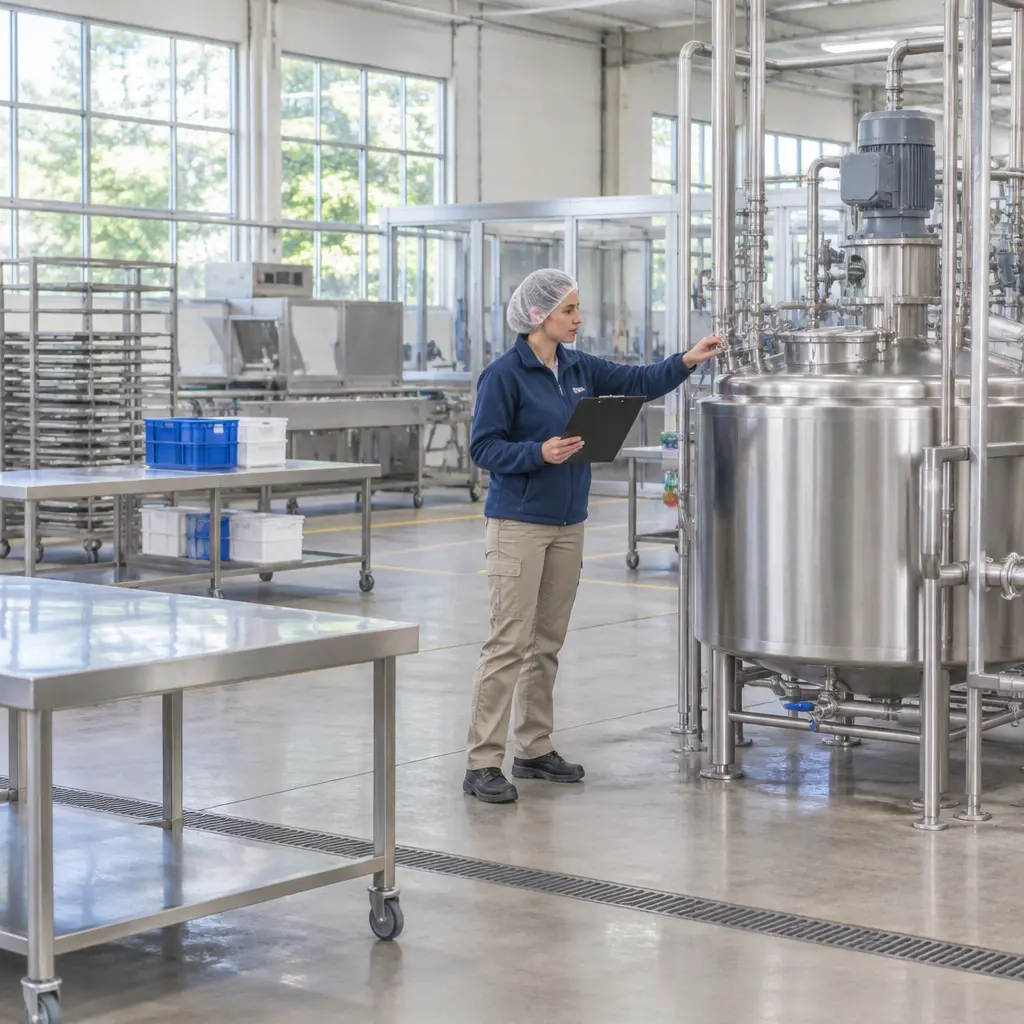
Shared-facility processing integrity is the set of controls used to protect a product’s identity, safety, and quality when equipment, rooms, people, or utilities serve more than one product or operation. Preventing contamination depends on matching the controls to the hazard: assess cross-contact and cross-contamination risks, separate incompatible activities, validate cleaning, manage people and materials, and verify that controls work. The U.S. Food and Drug Administration (FDA) requires applicable food facilities to establish risk-based preventive controls, while the Centers for Disease Control and Prevention (CDC) estimates that foodborne diseases cause 48 million illnesses, 128,000 hospitalizations, and 3,000 deaths in the United States each year. These figures underline why shared-space safeguards matter across food, pharmaceutical, and other regulated production.
Risk assessment defines shared-facility processing integrity
Processing integrity is a principle in the AICPA Trust Services Criteria concerning whether a system achieves its objectives effectively and as intended. In manufacturing, the phrase is also used more broadly for controls that help ensure products are made, handled, and released according to specifications. The AICPA’s definition is specific to system processing; facility-level contamination prevention is best understood as an operational application of integrity principles, not as a separate AICPA certification standard.
In food production, FDA regulations require covered facilities to identify known or reasonably foreseeable hazards and establish preventive controls where needed. The relevant hazards may include biological, chemical, and physical contamination, as well as allergen cross-contact. The appropriate controls depend on the product, process, and facility; a shared line does not automatically create unacceptable risk, but it does require a reasoned assessment and reliable safeguards.
Hazard analysis and risk-based controls
Hazard analysis is the systematic identification and evaluation of hazards that could make a product unsafe or otherwise unsuitable. FDA’s Current Good Manufacturing Practice, Hazard Analysis, and Risk-Based Preventive Controls for Human Food rule requires covered facilities to prepare a written hazard analysis and, when hazards require control, establish appropriate preventive controls. Those controls can include sanitation, allergen controls, process controls, supply-chain controls, monitoring, corrective actions, and verification.
A useful assessment maps where products, ingredients, people, tools, waste, and air or water can move between operations. It considers the consequence and likelihood of transfer, the ability to detect a failure, and whether products are exposed or protected at each step. FDA regulations require reanalysis when significant changes occur or when new information indicates that the hazard analysis may no longer be adequate.
Cross-contamination and allergen cross-contact
Cross-contamination is the unintended transfer of a contaminant, such as a pathogen or chemical, between products, equipment, or surfaces. Allergen cross-contact is the unintended incorporation of an allergen into a food that is not intended to contain it. The distinction matters because a sanitation program that manages microbial hazards may not, by itself, adequately control allergen residues.
The CDC’s annual U.S. foodborne-illness estimates describe the wider public-health stakes, though they are not estimates of illness caused specifically by shared facilities. FDA’s Food Allergen Labeling and Consumer Protection Act identifies eight major food allergens, and the Food Allergy Safety, Treatment, Education, and Research Act of 2021 added sesame as the ninth major allergen, effective January 1, 2023. Shared-facility allergen programs therefore need current ingredient information, clear product identification, suitable production sequencing, validated cleaning, and accurate labels.
Facility zoning and separation reduce contamination pathways
Zoning is the deliberate organization of rooms, equipment, people, and product flows to limit the movement of hazards from one area to another. It may use physical barriers, dedicated equipment, controlled access, time separation, or a combination of measures. The design should follow the hazard assessment rather than rely on color-coded floors or signage alone.
Codex Alimentarius’ General Principles of Food Hygiene recommends hygienic design and practices that prevent contamination, including managing movement between areas with different hygiene requirements. For shared facilities, the key question is whether the layout and operating rules prevent a plausible route of transfer, including indirect routes through workers, utensils, packaging, drainage, or maintenance activity.
Physical, temporal, and equipment separation
Physical separation uses walls, enclosed equipment, dedicated rooms, or barriers to limit contact and movement. Temporal separation uses different production times for incompatible products or activities, followed by appropriate cleaning and line clearance. Dedicated tools and utensils can provide another layer of separation, particularly where a hazard is difficult to remove or where the consequences of transfer are serious.
No single separation method is universally sufficient. A facility may combine dedicated allergen-handling tools with production sequencing and a validated cleanup, or use enclosed processing to protect exposed product while nearby work continues. FDA’s preventive-controls framework calls for controls appropriate to the identified hazard; it does not prescribe one zoning blueprint for every facility.
People, materials, and traffic flows
Personnel and materials can carry contamination across boundaries even when equipment is separated. Traffic controls can include designated entrances, handwashing and protective-clothing procedures, controlled movement of ingredients and packaging, and rules for waste and rework. The facility should also account for contractors, visitors, maintenance staff, and shared tools.
A practical flow map can show raw-to-ready-to-eat product movement, personnel routes, utensil exchange, and waste removal. Where flows must cross, documented practices should specify how the crossing is controlled. This approach links zoning to sanitation: separation reduces the chance of contamination, while cleaning and verification address residual risk.
Sanitation and changeover controls verify shared-line readiness
Sanitation is the set of practices used to clean and maintain equipment and facilities so they do not contaminate products. In a shared facility, a changeover is the controlled transition from one product or activity to another. FDA food regulations require written sanitation procedures for applicable facilities and require sanitation preventive controls when the hazard analysis identifies sanitation as necessary to control a hazard.
Cleaning removes soil and residues; sanitizing reduces microorganisms on cleaned surfaces to an appropriate level. These are related but distinct steps. A procedure should specify the equipment and surfaces covered, disassembly needs, cleaning agents and concentrations, contact times, rinsing requirements, responsible staff, and records. The details must suit the product and hazard rather than be copied without validation from another line.
Cleaning validation and verification
Validation provides evidence that a procedure is capable of controlling the hazard under defined conditions. Verification checks that the procedure was performed and continues to work as intended. FDA’s preventive-controls rule distinguishes these functions: validation is required for process controls, subject to specified exceptions, while verification activities may include record review, calibration, product testing, and environmental monitoring where appropriate.
The method should match the question. Visual inspection can identify visible residue but cannot establish that an allergen or microorganism is absent. Allergen-specific tests, protein-residue tests, microbial swabs, or other analytical methods may offer additional evidence, but each has limits tied to sampling location, detection threshold, and test design. A defensible program records the rationale, acceptance criteria, sampling plan, results, and corrective actions.
Changeover, line clearance, and production sequencing
Line clearance is the documented removal or control of materials and labels from the prior run before the next product begins. A robust changeover checks product-contact surfaces, utensils, packaging, ingredient staging, rework, and electronic or paper production instructions. It also confirms that the correct product identity and label are in place before release.
Production sequencing can reduce cleaning burden by scheduling products from lower-risk to higher-risk allergen profiles, or from products with fewer relevant hazards to those with more, when supported by the facility’s assessment. Sequencing is not a substitute for necessary cleaning. The schedule should account for exceptions such as urgent orders, maintenance interruptions, or a failed verification result.
Monitoring, traceability, and corrective action sustain integrity
A control system is dependable only when staff can detect deviations, contain affected product, and learn from failures. FDA’s food preventive-controls rule requires monitoring procedures for preventive controls, corrective actions for problems, verification activities, and records. These elements turn written procedures into an operating system that can be evaluated over time.
Useful performance measures may include sanitation pass rates, allergen-test failures, environmental-monitoring trends, deviations by line or shift, repeat cleaning events, and time to close corrective actions. These are facility-level indicators, not universal regulatory targets. A rise in repeat failures can signal a design problem, an inadequate procedure, training gaps, or maintenance issues rather than isolated operator error.
Environmental monitoring and trend analysis
Environmental monitoring samples the production environment for specified microorganisms or indicators to assess whether sanitation and hygienic controls are effective. It is especially relevant when the hazard analysis identifies an environmental pathogen as a hazard requiring a preventive control. Sampling locations should reflect likely harborage and transfer routes, and results should be reviewed as trends rather than treated only as individual pass-or-fail events.
FDA’s rules require environmental monitoring when it is appropriate to verify the effectiveness of sanitation controls for an environmental pathogen. A positive result should trigger a response proportionate to the risk, which may include intensified cleaning, investigation of nearby product and equipment, resampling, and review of the zoning or sanitation design. A negative sample does not prove that every surface is free of contamination, so monitoring must be interpreted alongside other evidence.
Records, traceability, and corrective actions
Records show what was produced, what controls were applied, who performed them, and what happened when results were outside limits. Traceability connects ingredients and packaging to production lots and distribution records, enabling faster investigation and product containment. FDA’s Food Safety Modernization Act established requirements for covered facilities to maintain records supporting their food-safety plans and their implementation.
When a control fails, the response should identify affected product, prevent its release or distribution when needed, correct the cause, and evaluate whether the food may be unsafe. Root-cause analysis should consider equipment condition, procedure design, workload, training, supplier changes, and facility layout. Repeatedly retraining staff without examining system causes can leave the original contamination pathway intact.
Shared-facility controls apply across regulated industries
The same broad integrity logic appears in pharmaceutical manufacturing, although the governing requirements and technical expectations differ from food rules. FDA current good manufacturing practice regulations for drugs require appropriate equipment cleaning and maintenance, written procedures, and controls to prevent contamination and mix-ups. A food facility should not treat pharmaceutical rules as its own legal standard, but the comparison illustrates how regulated sectors use documented processes, qualified equipment, and evidence-based verification.
Food facilities and allergen changeovers
Consider a bakery that produces items with and without sesame on the same line. Its assessment would identify sesame as a major allergen, map the movement of flour and toppings, evaluate airborne dust and shared tools, and determine whether scheduling, containment, cleaning, and label checks adequately control cross-contact. Since sesame became a major allergen under U.S. law on January 1, 2023, ingredient and label controls must reflect that change for applicable products.
The example demonstrates why a written cleaning instruction alone is not enough. The facility needs evidence that the method works for its equipment and residue conditions, plus a reliable way to prevent packaging or labeling errors. A failed test or unexpected residue should lead to product assessment and corrective action, not merely a repeat of the same unexamined procedure.
Pharmaceutical multiproduct equipment
A pharmaceutical manufacturer using equipment for multiple products must control residues and prevent mix-ups according to applicable drug CGMP requirements. FDA regulations require written procedures for cleaning and maintaining equipment, and equipment cleaning records must document relevant activities. The precise acceptance criteria and validation strategy depend on the products, process, equipment, and applicable regulatory expectations.
This example reinforces a cross-industry lesson: shared use is manageable when hazards are understood, equipment is suitable, controls are documented, and evidence supports release decisions. The legal framework, test methods, and risk thresholds remain sector-specific, so facilities should consult the regulations and qualified specialists that govern their products.
Conclusion: processing integrity depends on layered prevention
Shared-facility processing integrity begins with a credible hazard assessment, then connects zoning and separation to validated sanitation, disciplined changeovers, monitoring, traceability, and corrective action. CDC’s estimates of 48 million U.S. foodborne illnesses annually show the broader public-health importance of preventing contamination, while FDA requirements make risk-based controls and records central to covered food operations. No single barrier is sufficient in every setting; dependable protection comes from layers designed around actual transfer pathways.
Facility leaders should review their hazard analyses after process or ingredient changes, verify that cleaning methods work on real equipment, trend monitoring results, and test whether product and personnel flows match written procedures. For further action, consult FDA food preventive-controls guidance, the applicable sector regulations, and Codex food-hygiene principles, then involve qualified food-safety or quality professionals in adapting them to the facility.
Sources: American Institute of Certified Public Accountants, Trust Services Criteria, https://www.aicpa-cima.com/resources/download/2017-trust-services-criteria-with-revised-points-of-focus-2022; Centers for Disease Control and Prevention, Estimates of Foodborne Illness in the United States, https://www.cdc.gov/foodborneburden/estimates-overview.html; U.S. Food and Drug Administration, Current Good Manufacturing Practice, Hazard Analysis, and Risk-Based Preventive Controls for Human Food, https://www.ecfr.gov/current/title-21/chapter-I/subchapter-B/part-117; Codex Alimentarius Commission, General Principles of Food Hygiene, CXC 1-1969, https://www.fao.org/fao-who-codexalimentarius/codex-texts/codes-of-practice/en/; U.S. Food and Drug Administration, Food Allergies, https://www.fda.gov/food/food-labeling-nutrition/food-allergies; U.S. Food and Drug Administration, Food Safety Modernization Act, https://www.fda.gov/food/guidance-regulation-food-and-dietary-supplements/food-safety-modernization-act-fsma; U.S. Food and Drug Administration, Current Good Manufacturing Practice for Finished Pharmaceuticals, https://www.ecfr.gov/current/title-21/chapter-I/subchapter-C/part-211.

