
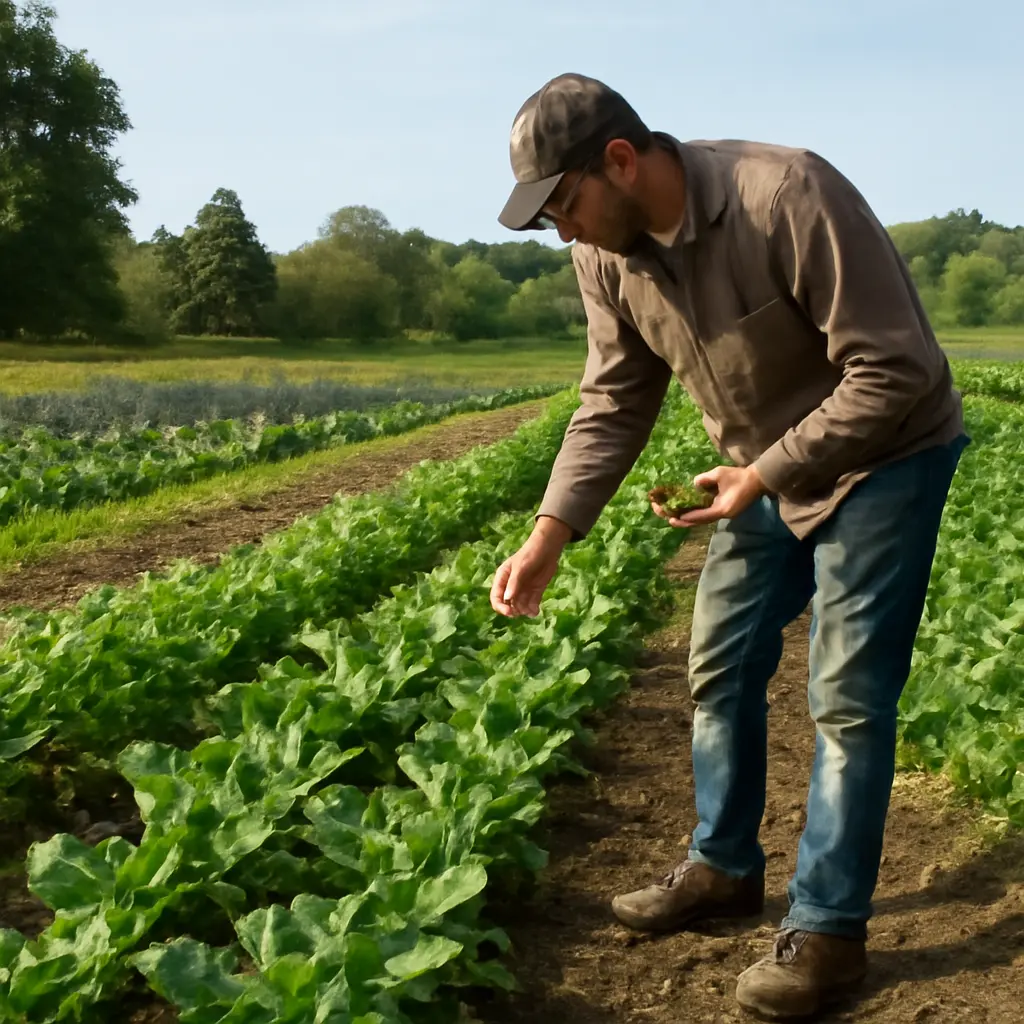
Organic farming is a system of crop and livestock production that emphasizes ecological processes, biodiversity, and cycles suited to local conditions while restricting most synthetic fertilizers and pesticides. It can support sustainable food production by improving soil management, reducing reliance on synthetic inputs, and encouraging diverse farm landscapes—but results depend on crop, region, management, and the impacts being measured. The global organic market reached about €135 billion in retail sales in 2022, according to the Research Institute of Organic Agriculture (FiBL) and IFOAM–Organics International, while organic agriculture covered 96.4 million hectares. This article explains organic standards, soil and biodiversity practices, water and climate considerations, yields and food security, and real-world examples, while noting the trade-offs that shape organic farming’s contribution to sustainability.
Organic standards define how organic farming supports sustainable production
Organic agriculture is not simply farming without chemicals. The Food and Agriculture Organization of the United Nations (FAO) describes organic agriculture as a holistic production-management system that promotes and enhances agroecosystem health, including biodiversity, biological cycles, and soil biological activity. Certification rules translate that broad approach into requirements for production, handling, and labeling. Organic certification therefore describes how food was produced; it is not, by itself, a guarantee that a product has lower environmental impacts in every category.
Standards vary by jurisdiction, but commonly require farmers to use approved inputs, maintain records, prevent prohibited substances from contaminating certified land, and follow rules for crop rotations and livestock. In the United States, the Department of Agriculture’s National Organic Program sets production and handling standards; the European Union has its own organic regulation. Organic rules restrict most synthetic pesticides and fertilizers, although they permit specified substances under defined conditions. Practices such as crop rotation, composting, cover cropping, and biological pest control are central ways of meeting the system’s goals.
Certification and permitted inputs
Certification is an independently verified process for demonstrating compliance with an organic standard. In the United States, the USDA requires certified operations to maintain an organic system plan and undergo inspections, with limited exemptions for some small operations. Organic farmers may use certain approved pesticides or soil amendments when necessary, so “organic” does not mean “pesticide-free.” The relevant distinction is whether a substance and its use are allowed by the applicable standard.
Preventive management and ecological principles
Organic production emphasizes prevention: farmers build soil fertility, select suitable crop varieties, rotate crops, and use habitat or mechanical methods to manage pests before relying on permitted inputs. These measures connect certification with broader agroecological aims. Their effectiveness depends on thoughtful design—for example, a rotation is more useful when crops differ in rooting depth, nutrient demand, and pest susceptibility than when it merely alternates similar crops.
Organic farming improves soil health through rotations and organic matter
Soil health refers to a soil’s continuing capacity to function as a living ecosystem that sustains plants, animals, and people. Organic farming supports this capacity through practices such as cover crops, compost and manure management, diversified rotations, and reduced exposure to some synthetic inputs. The National Organic Program requires practices that maintain or improve soil organic matter, manage nutrients, and minimize soil erosion. These methods can strengthen soil structure and biological activity, though outcomes depend on soil type, weather, tillage, and nutrient management.
Cover crops and crop rotation
Cover crops are plants grown primarily to protect and improve soil rather than to be harvested as the main product. They can shield bare ground from erosion, take up leftover nutrients, add organic matter, and—in the case of legumes—contribute biologically fixed nitrogen. Rotations interrupt pest and disease cycles and distribute nutrient demands across different crops. The USDA Natural Resources Conservation Service identifies cover cropping as a conservation practice that can improve soil cover, water infiltration, and nutrient cycling; its performance depends on choosing species and planting dates suited to local conditions.
Compost, manure, and nutrient cycling
Nutrient cycling is the movement and reuse of elements such as nitrogen and phosphorus through soil, plants, animals, and organic residues. Compost and properly managed manure can return nutrients and carbon to fields, supporting soil organisms and structure. However, organic nutrient sources are not automatically harmless: poorly timed or excessive applications can release nutrients into waterways or contribute to greenhouse-gas emissions. Soil testing, application planning, and appropriate storage are therefore essential parts of sustainable organic management.
Organic farming supports biodiversity and ecological pest management
Biodiversity includes the variety of organisms, genes, and ecosystems found in agricultural landscapes. Organic systems can support biodiversity by reducing use of many synthetic pesticides and by incorporating rotations, hedgerows, flowering strips, and other habitats. A 2014 meta-analysis by Sean Tuck and colleagues in the Journal of Applied Ecology found that organic farming had, on average, 34% greater species richness and 50% greater abundance of organisms than conventional farming across the studies reviewed. The size of the benefit varied among organism groups and landscapes, so the figures should not be treated as universal outcomes for every farm.
Habitat, pollinators, and beneficial organisms
Beneficial organisms—including pollinators, predatory insects, and soil microbes—can contribute to crop reproduction, pest regulation, and nutrient cycling. Field margins, flowering plants, and diverse crop sequences can provide food or shelter for some of these species. The FAO’s work on pollination notes that animal pollinators affect roughly 35% of global crop production by volume across crops that benefit from animal pollination. That statistic describes the importance of pollination generally, not an effect attributable to organic farming alone.
Integrated pest management
Integrated pest management (IPM) combines prevention, monitoring, and carefully selected control methods to keep pests below damaging levels. Organic IPM may use crop rotation, resistant varieties, physical barriers, biological controls, and approved pesticides when needed. It can reduce dependence on broad-spectrum chemical controls, but it requires observation and planning. Farmers must also consider whether an approved treatment could affect non-target organisms, since a substance’s organic status does not remove the need for responsible use.
Organic farming affects water quality and climate through management choices
Water and climate outcomes depend less on an organic label alone than on decisions about soil cover, tillage, irrigation, manure, and nutrient timing. Organic practices can limit some pathways of pollution by avoiding many synthetic inputs and by improving soil infiltration and ground cover. Yet nutrient runoff, erosion, and emissions can still occur in organic systems. Comparing farms fairly requires measuring impacts per hectare as well as per unit of food produced, because differences in yields can change the interpretation.
Water protection and erosion control
Water quality describes the suitability of water for a particular use, assessed through physical, chemical, and biological characteristics, as the U.S. Geological Survey explains. Cover crops, buffer strips, and careful nutrient applications can reduce soil and nutrient movement from fields into waterways. Organic certification does not itself ensure that runoff is prevented; for example, poorly managed manure can contribute nitrogen and phosphorus to streams. Conservation measures must be adapted to local slope, rainfall, soils, and drainage.
Greenhouse gases and carbon storage
Greenhouse-gas performance includes emissions of carbon dioxide, methane, and nitrous oxide, as well as changes in soil carbon. Organic systems may use less energy-intensive synthetic nitrogen fertilizer, and practices that increase soil organic matter can store carbon. But lower yields in some crop and location combinations may mean more land is needed to produce the same quantity of food, potentially shifting impacts elsewhere. A 2017 study by Laurent and colleagues in Nature Communications found that organic farming’s environmental advantages and disadvantages varied by impact category and whether comparisons were made per area or per product. This is why claims about climate benefits need clearly stated boundaries and metrics.
Organic farming’s yields and economics shape its contribution to food security
Food security means reliable access to sufficient, safe, and nutritious food. Organic farming can contribute through farm income, local knowledge, diversified production, and reduced dependence on some purchased inputs. At the same time, yield differences, certification costs, labor needs, market access, and price premiums affect whether farmers can adopt it and how much food it supplies. Organic production is therefore one approach within a broader sustainable food system, not a single solution to hunger or resource constraints.
Yield gaps and crop-specific outcomes
A yield gap is the difference in harvest between production systems or between actual and attainable yields. A 2012 meta-analysis by Verena Seufert and colleagues in Nature reported that organic yields were, on average, about 25% lower than conventional yields in the studies they analyzed, with substantial variation by crop and management. The authors also found that certain practices, including multi-cropping and crop rotation, narrowed the gap. This average does not predict the result for an individual farm: local climate, soil fertility, pest pressure, crop choice, and farmer experience matter.
Farm economics and market access
Organic farm economics reflect production costs, labor, certification, yields, and the price farmers receive. FiBL and IFOAM–Organics International reported global organic retail sales of approximately €135 billion in 2022, indicating a substantial market, but sales growth does not ensure equitable access or stable returns for every producer. Certification can be costly or administratively demanding, especially for small farms. Group certification, public extension services, transition assistance, and reliable local markets can help reduce these barriers.
Transition periods and resilience
Transition is the period when a farm changes its practices to meet organic standards before products can be marketed as certified organic. During this time, farmers may face new management demands and may not receive organic price premiums. Diversified rotations, locally adapted varieties, and strong soil management can support resilience—the capacity to withstand and recover from shocks such as drought, pests, or price volatility. Resilience is not guaranteed by certification; it depends on farm resources, landscape conditions, and access to advice and markets.
Real-world examples show how organic practices work in context
Examples help illustrate the difference between a production standard and the practical decisions that determine outcomes. Long-running research, regional policy, and farm-level projects can reveal which combinations of rotation, soil management, and market support are effective under particular conditions. They should be interpreted as evidence about specific settings rather than universal proof that one system always outperforms another.
The Rodale Institute Farming Systems Trial
The Rodale Institute’s Farming Systems Trial, established in Pennsylvania in 1981, compares organic and conventional grain-production systems over the long term. Its research has examined yields, soil quality, energy use, and performance under weather stress. Rodale reports that its organic systems have shown advantages in soil organic matter and water-holding capacity, while yield results differ by crop and conditions. Because the trial is based in one region and uses defined management systems, its findings are most useful as evidence of what sustained practices can achieve in that context.
The European Union’s organic sector
The European Union’s organic action plan seeks to expand organic production and consumption alongside wider environmental objectives. FiBL’s global organic statistics report that the EU had about 16.9 million hectares of organic agricultural land in 2022. Expansion at this scale makes implementation questions important: suitable rotations, processing infrastructure, consumer demand, and farmer support all influence whether growth delivers environmental and economic benefits.
Conclusion: organic farming is a tool for sustainable food production
Organic farming supports sustainable food production through soil-building practices, nutrient cycling, biodiversity, and ecological pest management. Evidence also shows important limits and trade-offs: yields vary, approved inputs still require careful use, and outcomes for water, climate, and wildlife depend on management and the scale at which impacts are measured. Certification provides a useful production framework, but it should be considered alongside farm-level performance, food access, and wider land-use effects.
Farmers can strengthen results by combining organic standards with locally adapted rotations, cover crops, habitat protection, precise nutrient management, and monitoring. Policymakers and buyers can help through transition support, research, extension, and dependable markets. Readers can learn more from the FAO, USDA National Organic Program, FiBL, and peer-reviewed farming-systems research, and can ask producers how they manage soil, water, and biodiversity—not just whether a product carries a label.
Sources: Food and Agriculture Organization of the United Nations, Organic Agriculture, https://www.fao.org/organicag/oa-faq/oa-faq1/en/; U.S. Department of Agriculture, National Organic Program, https://www.ams.usda.gov/about-ams/programs-offices/national-organic-program; Research Institute of Organic Agriculture (FiBL) and IFOAM–Organics International, The World of Organic Agriculture: Statistics and Emerging Trends 2024, https://www.fibl.org/en/shop-en/1747-organic-world-2024; Tuck, S. L., et al., “Land-use intensity and the effects of organic farming on biodiversity: a hierarchical meta-analysis,” Journal of Applied Ecology, 2014, https://doi.org/10.1111/1365-2664.12219; Food and Agriculture Organization of the United Nations, The Importance of Pollinators, https://www.fao.org/pollination/en/; Laurent, A., et al., “The environmental impact of organic agriculture: a critical review of the evidence,” Nature Communications, 2017, https://doi.org/10.1038/s41467-017-00254-8; Seufert, V., Ramankutty, N., and Foley, J. A., “Comparing the yields of organic and conventional agriculture,” Nature, 2012, https://doi.org/10.1038/nature11069; U.S. Geological Survey, Water Science School: Water Quality, https://www.usgs.gov/special-topics/water-science-school/science/water-quality; USDA Natural Resources Conservation Service, Cover Crops, https://www.nrcs.usda.gov/conservation-basics/natural-resource-concerns/soils/cover-crops; Rodale Institute, Farming Systems Trial, https://rodaleinstitute.org/science/farming-systems-trial/; European Commission, Action Plan for the Development of Organic Production, https://agriculture.ec.europa.eu/farming/organic-farming/organic-action-plan_en.


